INSIGHTS / AI WORKFLOWS
WhatsApp clinic bookings: when is an appointment actually confirmed?
A WhatsApp reply can acknowledge a booking request immediately. It should confirm an appointment only after the clinic's designated booking system has accepted the reservation and any required staff approval is complete. That distinction gives clinic owners a practical way to evaluate AI reception: can the system explain what has been requested, what is reserved and what still needs a person?
Consider a fictional clinic using a shared calendar without enforced booking capacity. A patient is asking for Tuesday at 10am. The assistant finds a free slot and replies, "You're booked." Meanwhile, a receptionist assigns that slot to someone at the counter. Both conversations sounded successful; the clinic now has a conflict to resolve. The missing component was control over the reservation, not better wording.
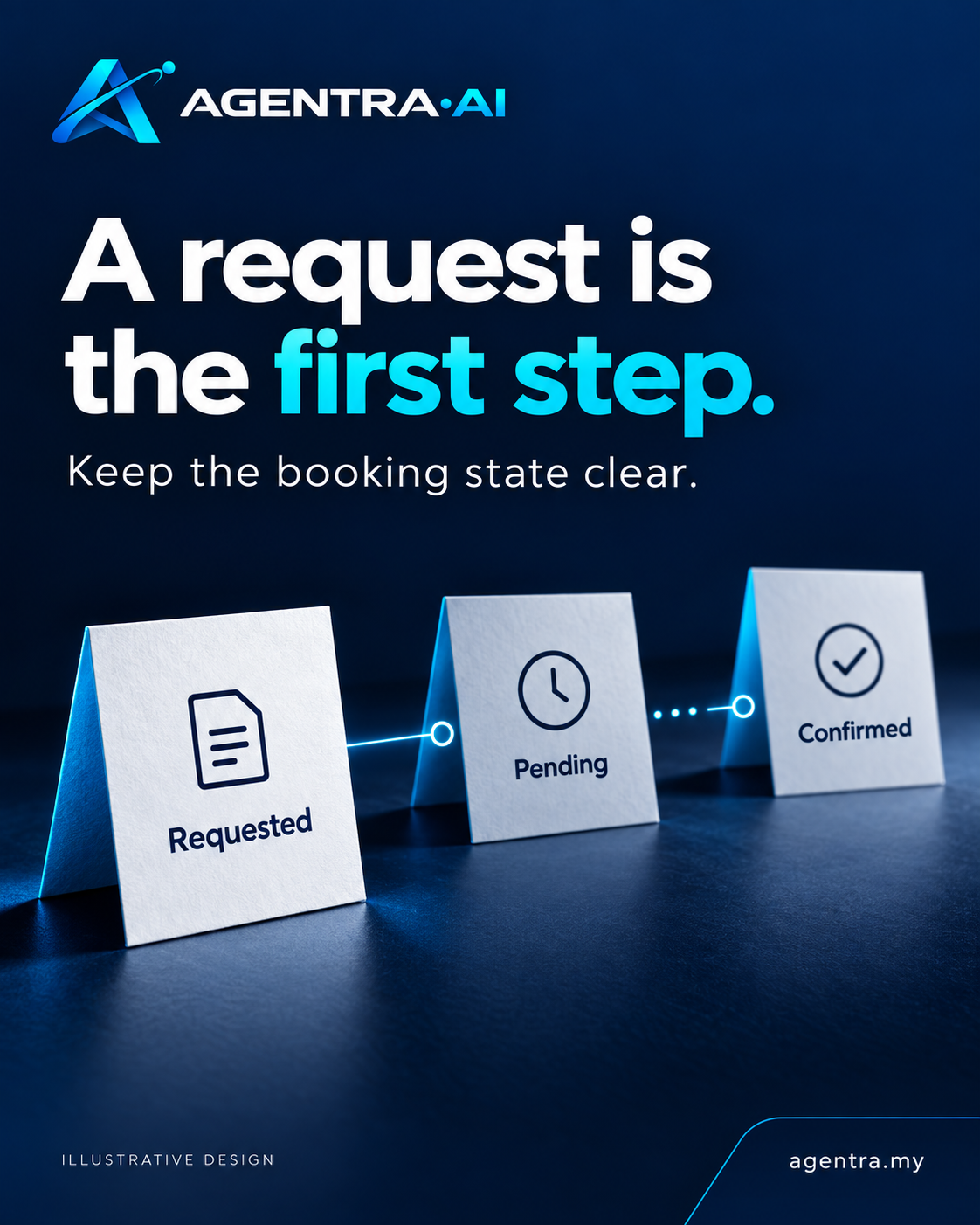
Define three states before writing the conversation
Start with a small vocabulary that staff and patients can understand. The following is a proposed workflow, not a claim about a deployed clinic integration.
- Requested: the clinic has received the preferred date, time and appointment type. No slot is promised.
- Pending: the request needs a capacity check, a staff decision or resolution of an uncertain system response. If the application implements temporary holds, say whether one exists and when it expires.
- Confirmed: the authoritative booking record contains the agreed appointment, required approval is recorded and the assistant can retrieve the booking reference and details.
Declined, cancelled and expired requests need explicit outcomes too. Avoid leaving a patient indefinitely in "pending." Assign an owner and a review deadline that the clinic can actually meet, with overdue requests visible in the staff work queue. If staff are unavailable overnight, communicate the next staffed review period instead of promising an arbitrary response time.
Availability is useful evidence, but it is not a reservation
An availability lookup answers a narrower question than a booking operation. For example, Google's Freebusy API returns busy intervals for calendars. That response does not itself reserve an appointment.
The implementation therefore needs a defined point at which capacity is committed. Depending on the clinic's software, this might be a booking endpoint that rejects conflicts, a temporary hold followed by confirmation, or a staff-controlled queue. Simply reading a calendar and then adding an event is not, by itself, a guarantee against simultaneous bookings.
Ask the supplier to demonstrate two people requesting the same slot at the same time. The acceptable result is one valid booking and a clear alternative or pending response for the other person. Ask which mechanism enforces capacity, and request a repeatable test. If the system cannot enforce the rule, keep confirmation with staff until that limitation is resolved. This trades immediate booking for oversight; automatic confirmation is more useful for appointment types whose capacity and approval rules can be enforced reliably.
Connect the words to the clinic's actual rules
A generic calendar status is not automatically the clinic's business definition of confirmation. Google's Events reference lists confirmed as the default event status and separately tracks attendee responses. That default does not establish that a separate clinic approval happened.
Map the clinic's rules explicitly: which calendar or practice system is authoritative, who may approve, which appointment types require review, and how room or practitioner capacity is checked. Include the date, local time, location and appointment type in the patient-facing confirmation. An ambiguous "Tuesday morning" should become a specific agreed appointment before it is committed.
Handle retries and changes as part of booking
Suppose the booking request reaches the system, but its reply times out. Sending another create request immediately can create a duplicate. A better design assigns the original request a stable reference, checks whether the booking already exists, and retries only according to the booking system's documented behaviour. If the outcome remains unknown, say that confirmation is pending and route it to staff.
Rescheduling deserves the same care. Define whether the old booking stays active until the replacement is secured. Do not cancel a valid appointment first unless that is the agreed policy. Cancellation messages should reflect the recorded booking change, and reminders should use the latest state rather than an earlier conversation summary.
Keep the booking state separate from communication. A recorded reservation does not prove the patient saw the WhatsApp confirmation. The staff queue should show outstanding notification work, while repeat messages about the same booking should resolve to its existing reference.
Test the work a receptionist would otherwise inherit
Before launch, run a short acceptance exercise with fictional records:
- Two requests compete for one slot: only the permitted capacity is confirmed.
- A booking response times out: reconciliation finds the existing record or routes uncertainty to staff without duplicating it.
- Staff decline a request: the patient receives a clear outcome and the pending queue closes.
- A patient changes the time: the authoritative record and subsequent reminder agree.
- A pending request crosses the staffed review deadline: the designated owner can see and act on it.
Track unresolved requests and reconciliation work alongside response speed. A fast first reply is useful; a reception workflow becomes valuable when staff can trust its booking state and intervene with enough context.
For Agentra, the engineering question is how AI connects a conversation to a verifiable business action. Explore our clinic reception application or the broader principle of evidence before claiming completion. To evaluate a clinic workflow, bring a sample booking journey and the rules your staff currently use to a conversation with Agentra.